Hardly any interior style has shown such staying power. What emerged between the late 1940s and the early 1970s fills Pinterest boards, design magazines and – yes – plenty of living rooms today. Mid-Century Modern is more than a retro trend. It is a design attitude born out of a very particular historical situation, and its core principles still convince us today.
A style out of the rubble
To understand Mid-Century Modern, you have to look back briefly. After the Second World War, Europe stood before nothing – and before the task of furnishing millions of homes. At the same time, the war had produced new materials and manufacturing techniques: plywood could be pressed into shapes never seen before, plastics became affordable, tubular steel was light and stable.
Out of this grew a design philosophy that left ornament behind and instead asked: what does a person really need? The answer was radically simple – and precisely for that reason so timeless.
The core principles of Mid-Century Modern
Function determines form
Every element has a purpose. A chair should be comfortable, a shelf should offer storage, a lamp should light the room well. Decoration for decoration’s sake? Not here. But that by no means makes Mid-Century furniture cold or sterile – quite the opposite. It is this very concentration on the essential that produces a calm elegance which fits into any room.
Organic shapes meet clean lines
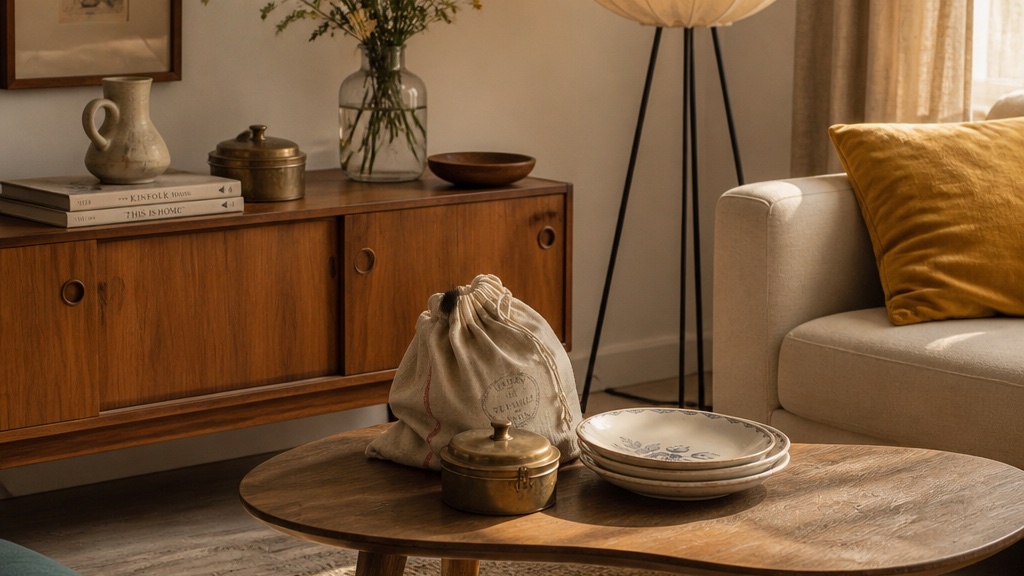
One of the most striking features: the combination of geometric clarity with soft, organic curves. The kidney-shaped table is probably the best-known example – a freely flowing form that nonetheless looks pared back. The gently curved armrests of a cocktail chair or the teardrop silhouette of a pendant lamp follow the same principle.
Honest materials
Mid-Century designers showed their materials rather than hiding them. Teak, rosewood, walnut and oak kept their visible grain. Brass oxidised and developed a patina. Leather grew softer and more beautiful over time. This honesty is one reason why so many pieces from this era age so gracefully – and why vintage examples are often more beautiful than their reproductions.
Lightness and transparency
Furniture of the Mid-Century era stands on slender, often splayed legs. Sideboards seem to float above the floor. Shelving is open, room dividers are permeable. The goal: rooms should be able to breathe. At a time when homes were getting smaller, that wasn’t just aesthetics – it was clever, too.
The big names – and the nameless masters
When Mid-Century Modern comes up, the big names are quick to follow: Charles and Ray Eames with their iconic plywood and fibreglass chairs, Arne Jacobsen with the Egg and the Ant, Hans Wegner with his more than 500 chair designs, George Nelson with the legendary Ball Clock. In Italy, Gio Ponti and Achille Castiglioni shaped their own, often more playful variant of the style.
But Mid-Century Modern was never solely the business of star designers. In Germany, manufacturers such as WMF, Rosenthal and countless smaller workshops produced everyday design at a high level. The ceramic vases with their typical lava glazes, the simple cutlery sets, the colourful wall clocks – they all belong to this era, even if their creators often remained unknown.
It is precisely these everyday pieces that make collecting Mid-Century so special: they are affordable, they have character, and they tell stories of perfectly ordinary life in an extraordinary time.
Recognising Mid-Century Modern: five features at a glance
Not everything that looks old and has splayed legs is automatically Mid-Century. These features help with the classification:
- Period: Created between roughly 1947 and 1972 – the transitions are fluid.
- Formal language: Organic curves, slender silhouettes, tapered or splayed legs.
- Materials: Teak, rosewood, walnut, moulded plywood, brass, ceramics, early plastics.
- Colours: Warm earth tones, plus bold accents in mustard yellow, orange, petrol blue or olive green.
- Details: Visible wood grain, minimalist handles (often metal), restrained or no ornamentation.
The style that never disappeared
In the 1980s and 1990s, many considered Mid-Century Modern dated – the kidney tables migrated to flea markets and cellars. But since the early 2000s the style has been experiencing a renaissance that continues to this day. And for good reason.
Mid-Century Modern suits our present because its values are astonishingly current: reduction instead of excess. Quality instead of quantity. Materials that are allowed to age. In a world shaped by short-lived trends and disposable furniture, these pieces offer a counter-proposal – not as a nostalgic escape, but as a conscious choice.
And perhaps that is exactly where the secret of this era lies. Mid-Century Modern was never a style that wanted to impress. It wanted to work, to look good and to last. That it became timeless in the process was probably not even planned – but it surprises no one either.
Browse the Bavarian Heritage shop
From ceramic vases with lava glaze to brass bowls to small design finds from the 1950s to the 1970s – in the Bavarian Heritage Etsy shop you’ll find carefully selected vintage pieces with a history. Do stop by and discover what the Mid-Century era has to offer.