Every piece in my shop has already been made once. For the plate, the mug or the book, no new clay had to be fired, no metal cast, no paper printed. That is the simplest and at the same time strongest reason why vintage is sustainable: what already exists does not have to be made again.
What already exists doesn’t have to be made
Behind every new object are raw materials, energy for production, packaging and transport. Buying a second-hand piece instead means using something whose production happened long ago. I deliberately don’t quote blanket CO₂ figures here. They vary enormously depending on material and product, and a figure for a T-shirt says little about a porcelain plate. But the principle applies to everything: at best, every reuse replaces a new purchase.
There is never a second one of a vintage gift. It has already lived a life, carries the traces of it and comes with a story you can tell as you hand it over. That is what makes it more personal than anything sitting on a shelf in a hundred identical copies. And it is more sustainable, too.
Which piece suits which occasion? Here are examples from my shop. First, the overview:
A broken handle does not have to be the end of a beautiful piece. Old beer steins in particular have often survived decades, so a careful repair is worthwhile. Recently, a grey-glazed stoneware stein landed on my work table: the solid handle had broken off cleanly at the top and bottom. A classic case for bonding with two-component adhesive.
Here I’ll show you how I go about it and what really matters.
A picture on the wall changes a room more than almost any other piece. Whether it radiates calm or looks lost depends less on the motif than on how it hangs. My shop has plenty that wants to go on a wall: maps and city views, lithographs, illustrations and above all wall plates. I’ll use them to show what matters when hanging.
The right height
The most common problem: pictures hang too high. A proven guide is the museum rule. The centre of the picture sits at roughly eye level, about 150 to 160 cm above the floor. That way a picture looks natural in the room instead of straining towards the ceiling.
Modern homes are often bright, calm and clear. That is exactly what makes them the perfect backdrop for old pieces. A hand-painted plate, a stoneware mug or a 1950s alarm clock brings warmth and history into a room that might otherwise look too sleek. A few simple principles help the result look curated rather than cluttered.
I don’t have photos from my customers’ homes. So I put together the three style mixes above from pieces in my shop, as inspiration for what goes well together.
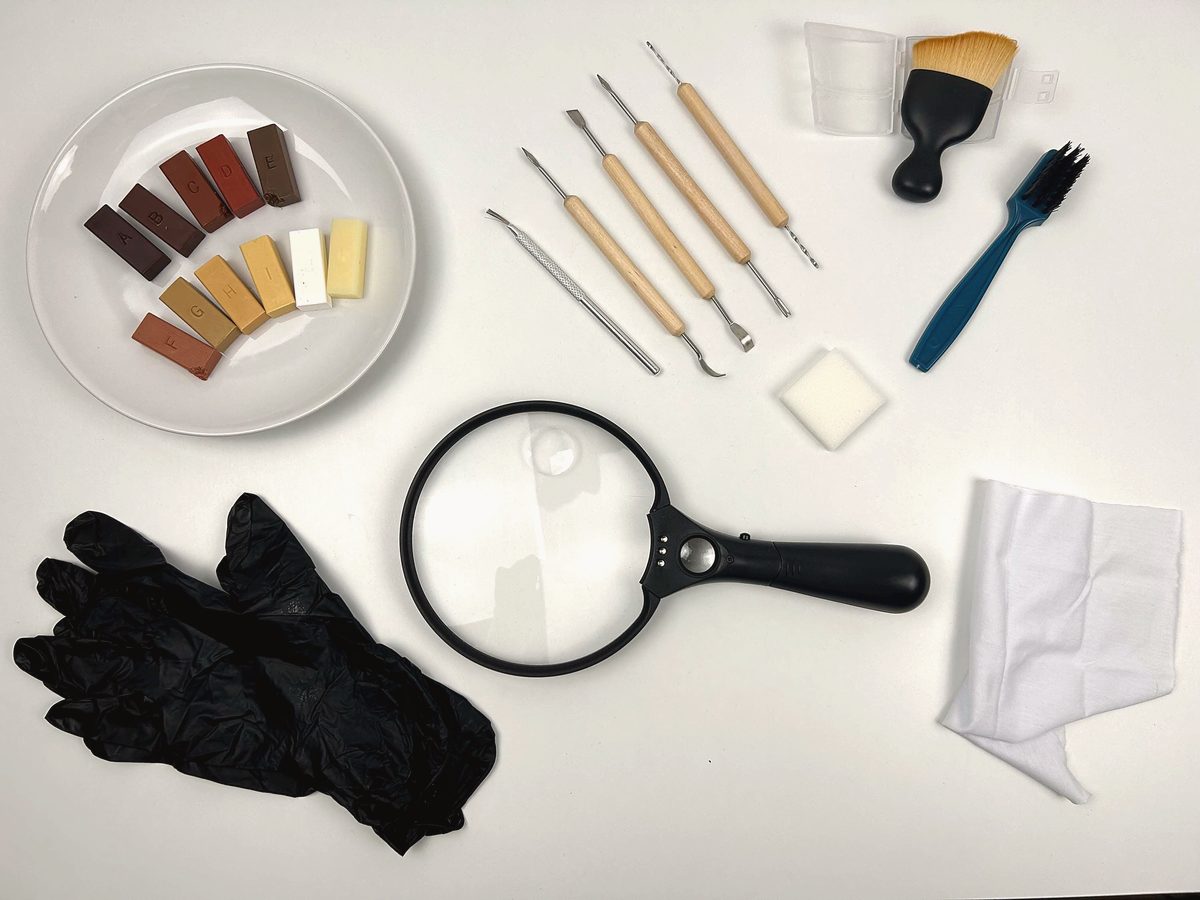
Before a piece goes into my shop, it is cleaned, checked and repaired if necessary. On my work table for this are a magnifying glass, brushes, wax sticks, modelling tools, gloves and soft cloths. But the most important rule for caring for old things needs no tools at all: as little as possible, as gently as necessary.